
Chapter 6: Marwan, Abdul Malik, and the Empire Built Through Fire
After the death of Yazid ibn Muawiya, chaos spread rapidly across the Islamic lands. Rebellions rose from Arabia to Iraq. Old tribal rivalries returned. Different leaders claimed authority. Some believed the Umayyad rule had lost moral legitimacy after Karbala.
THE BRIEF HISTORY OF ISLAM!
Danish Shafiq
6/18/20264 min read
Chapter 6: Marwan, Abdul Malik, and the Empire Built Through Fire
The wounds of Karbala had not healed.
Across the Muslim world, grief still moved silently through hearts. In Madinah, old companions of Prophet Muhammad ﷺ remembered the days when revelation still descended from the heavens. In Iraq, people whispered the name of Hussain RA with tears. In distant lands, Muslims wondered how the Ummah that once stood united behind the Prophet ﷺ had entered an age of bloodshed.
The empire remained vast. But spiritually, the Muslim world felt fractured. After the death of Yazid ibn Muawiya, chaos spread rapidly across the Islamic lands. Rebellions rose from Arabia to Iraq. Old tribal rivalries returned. Different leaders claimed authority. Some believed the Umayyad rule had lost moral legitimacy after Karbala.
And among those who stood firmly against Umayyad control was Abdullah ibn Zubair Radheya Allahu Aanhu.
The son of Zubair ibn al-Awwam RA — one of the greatest companions of Prophet Muhammad ﷺ. The grandson of Abu Bakr Siddiq RA through his mother Asma bint Abu Bakr RA. A man raised in the shadow of the earliest days of Islam. Abdullah ibn Zubair RA refused to accept Umayyad authority and established his leadership in Makkah itself. Many Muslims across Arabia, Iraq, and Egypt supported him.
For years, the Muslim world stood divided between rival powers. Then emerged Marwan ibn al-Hakam. An experienced politician from the Umayyad family. Marwan understood that the empire was slipping toward collapse. Through alliances and military strength, he slowly restored Umayyad control over Syria and nearby regions. But his reign was short. Soon, power passed to his son:
Abdul Malik ibn Marwan.
Abdul Malik was intelligent, disciplined, and politically determined. Unlike earlier rulers who inherited relative unity, he inherited a fractured empire standing on the edge of destruction.
He wanted order. He wanted central authority. And above all… he wanted the Umayyad state to survive.
But the road toward rebuilding the empire would leave painful marks upon Islamic history. To restore control, Abdul Malik relied heavily upon one of the most feared men of the age:
Hajjaj ibn Yusuf.
Even centuries later, the name of Hajjaj would continue to divide opinions among Muslims. Some remembered him as a brilliant administrator who restored discipline to a collapsing empire. Others remembered him as a symbol of fear and brutality.
And perhaps history remembers him as both.
Hajjaj was sharp, eloquent, and fiercely loyal to Abdul Malik. But he ruled with iron severity. Rebellions were crushed mercilessly. Opposition was silenced harshly. Then came one of the darkest moments of the era.
The siege of Makkah. The holiest city in Islam. The city where Prophet Muhammad ﷺ was born. The city toward which millions turned in prayer every day. Inside Makkah stood Abdullah ibn Zubair RA, refusing to surrender. Outside stood the forces of Hajjaj. The unthinkable soon happened. Catapults were raised against the sacred city. Stones and fire rained toward Makkah itself. The Kaaba — the House built for the worship of One God — was damaged during the conflict. For many Muslims, the shock was unbearable.
The sanctuary that even pre-Islamic Arabs had once respected during war now stood beneath siege by Muslims themselves. Inside the city, Abdullah ibn Zubair RA prepared for his final stand. Before the battle, he went to his elderly mother, Asma bint Abu Bakr RA. She was now blind with age. Yet her courage remained stronger than armies. Abdullah asked her: “Mother, what if they kill me?”
Asma RA replied with words history would never forget: “If you are upon the truth, then remain firm.”
Strengthened by her words, Abdullah ibn Zubair RA entered the battlefield knowing death awaited him. He fought until he was martyred. The son of a great companion. The grandson of Abu Bakr Siddiq RA. A man born in the earliest generation of Islam. His death marked the final collapse of resistance against Abdul Malik’s rule.
The Umayyad Empire was united once again… but at a heavy spiritual cost.
Many Muslims feared that political power had begun overshadowing the moral spirit that once defined the earliest Islamic community.
Yet history is rarely simple. Even amid fear and violence, Abdul Malik also transformed the empire in lasting ways. He centralized administration. Arabic became the language of governance across the empire.
Islamic coinage replaced Byzantine and Persian symbols.
In Jerusalem, he built the magnificent Dome of the Rock — a monument carrying verses declaring the Oneness of Allah above the sacred city.
The Muslim world was becoming more organized, more connected, and more politically powerful.
And while Hajjaj ruled Iraq with severity, new frontiers opened far beyond Arabia.
To the east, a young commander named Muhammad bin Qasim marched toward Sindh.
The lands near the Indian subcontinent had long been connected to Arab traders through the seas, but now Muslim armies entered the region militarily for the first time.
Cities in Sindh fell under Umayyad authority, and with them began one of the earliest political connections between Islam and India. For centuries to come, Islam in the Indian subcontinent would continue growing through traders, scholars, Sufis, rulers, and ordinary people.
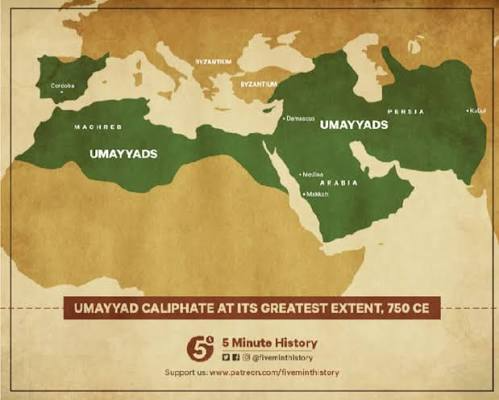
Meanwhile, in the far west, another young commander prepared for a different journey. Beyond North Africa lay a vast land the Arabs called Al-Andalus. A land of mountains, rivers, churches, castles, and ancient kingdoms. And soon, under the leadership of Tariq ibn Ziyad, Muslim armies would cross the sea itself.
The story of Islam was no longer confined to Arabia. It was becoming the story of civilizations. Yet beneath every victory, the memories of Karbala… Makkah… and the blood of Muslims spilled by Muslims still haunted the conscience of the Ummah.
The empire had survived.
But the soul of the Muslim world was still searching for peace.
End of Chapter 6
Chapter 7: The Black Banners from Khurasan — The Fall of the Umayyads