
Chapter 7: From Sindh to Spain — The Expansion of the Umayyad World
Under Abdul Malik ibn Marwan, the Umayyad Empire slowly regained control over its fractured territories. Roads reopened. Administration strengthened. Coins bearing Islamic inscriptions spread across markets. Arabic became the language of governance from Syria to Egypt.
THE BRIEF HISTORY OF ISLAM!
Danish Shafiq
6/15/20265 min read


Yet despite his harshness, Hajjaj was also an able administrator who strengthened roads, communication, taxation systems, and military organization. Under his authority, the Umayyad Empire pushed toward two distant frontiers:
Sindh in the East… and Spain in the West.
Two journeys.
Two young commanders.
And two chapters that would permanently shape Islamic history.
To the East lay Sindh — a land connected to Arabia for centuries through trade across the Arabian Sea. Arab merchants had long visited the western coasts of India, carrying spices, cloth, perfumes, and stories between civilizations. But now the Umayyad state sought military entry into the region. The campaign was entrusted to a young commander barely in his late teens:
Muhammad bin Qasim.
Young in age… but disciplined and ambitious.
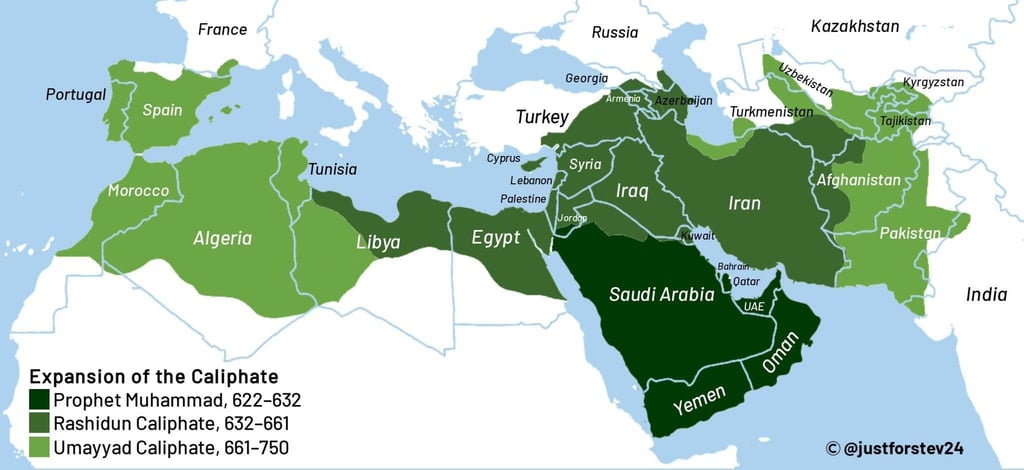
Marching through harsh terrain with Umayyad forces, Muhammad bin Qasim entered Sindh in the early 8th century. Battles followed against Raja Dahir, the local ruler. Eventually, the Umayyad forces captured important cities including Debal and Multan. For the first time, parts of the Indian subcontinent came under formal Muslim political rule.
Yet the story of Islam in India would become far larger than conquest alone.
Over centuries, Islam in the subcontinent would spread not merely through rulers, but through traders, Sufis, saints, scholars, and ordinary people whose character and spirituality touched hearts across cultures.
Still, Muhammad bin Qasim’s expedition marked an important historical beginning. A door had opened between India and the wider Islamic world. While Muslim armies advanced eastward into Sindh, another astonishing journey unfolded in the far West.
Across North Africa lay the vast waters of the Mediterranean. Beyond those waters stood the Iberian Peninsula — present-day Spain and Portugal. A land of churches, castles, rivers, and divided kingdoms.
And toward that unknown frontier marched another commander:
Tariq ibn Ziyad.
In the year 711 CE, Tariq crossed the sea with a relatively small force composed largely of Berber Muslims from North Africa. Ahead of them stood the Visigothic Kingdom. Behind them stretched the sea itself. According to famous narrations remembered across centuries, Tariq inspired his soldiers with words that captured the spirit of their mission:
“The enemy is before you and the sea is behind you.”
Soon the Muslim forces achieved a stunning victory against King Roderic. Cities began falling one after another. Cordoba. Toledo. Granada. Seville. And gradually, much of the Iberian Peninsula entered Muslim rule under what became known as Al-Andalus. But the greatness of Al-Andalus would not merely emerge from conquest.
It would emerge from civilization. Mosques became centers of learning. Libraries filled with books. Scholars studied astronomy, medicine, mathematics, philosophy, and engineering. Water systems transformed cities. Poetry flourished. Architecture reached extraordinary beauty. In cities like Cordoba, lamps illuminated streets at night while much of medieval Europe remained in darkness.
And among those who found periods of refuge and intellectual opportunity in Muslim Spain were many Jewish communities escaping persecution elsewhere in Europe. Al-Andalus became one of history’s great centers of learning and cultural exchange. Yet while expansion brought glory abroad, tensions continued within the Muslim world itself.
Many people still remembered Karbala. Many still questioned the growing power of Umayyad rulers. And many scholars worried that political authority was becoming increasingly distant from the simplicity and moral spirit of the earliest Islamic generation.
Even the great commanders who expanded the empire would not escape political uncertainty. After the death of powerful figures like Abdul Malik and Hajjaj, the political atmosphere shifted.
Muhammad bin Qasim, despite his victories in Sindh, was suddenly recalled.
Historical reports differ regarding the details of his final days, but many traditions describe a tragic and painful ending after changes within Umayyad leadership. The young conqueror who had opened the gates of Sindh disappeared from power almost as quickly as he had risen.
Tariq ibn Ziyad too faded quietly from political prominence despite his extraordinary role in the conquest of Spain. History can be unforgiving even to those who build empires. And slowly, beneath the surface of Umayyad power, dissatisfaction continued growing. Some opposed Umayyad political authority. Some resented Arab tribal dominance over non-Arab Muslims. Some remained deeply attached to the memory of Ahl al-Bayt. Others sought a different vision for the future of the Muslim world.
The empire that stretched from Sindh to Spain appeared mighty from the outside…but inside, cracks were beginning to spread. Still, despite conflict and controversy, the Umayyad period permanently changed world history. Trade routes connected civilizations. Arabic spread across continents. Architecture evolved. Knowledge traveled between cultures.
And Islam became a global civilization stretching across three continents. But no empire remains untouched forever.
And soon, from the lands of Khurasan in the East, a new revolutionary movement would rise under black banners…bringing with it the fall of the Umayyads and the birth of a new Islamic age:
The Abbasid Era.
End of Chapter 7
Chapter 7: From Sindh to Spain — The Expansion of the Umayyad World
The Muslim world stood between glory and grief.
Only a few decades earlier, the sands of Karbala had witnessed one of the darkest tragedies in Islamic history. The blood of Hussain ibn Ali Radheya Allahu Aanhu still lived in the memory of the Ummah. In Makkah, the scars of siege and civil war had shaken the hearts of believers. The House of Allah itself had seen conflict between Muslims.
Yet history does not stop for sorrow.
Under Abdul Malik ibn Marwan, the Umayyad Empire slowly regained control over its fractured territories. Roads reopened. Administration strengthened. Coins bearing Islamic inscriptions spread across markets. Arabic became the language of governance from Syria to Egypt.
The empire was becoming more organized, more centralized, and more powerful. But while palaces and governors strengthened the state, another reality existed quietly beside the world of politics. Far from royal courts and armies, many from the family of Prophet Muhammad ﷺ chose distance from power.
The surviving members of the Ahl al-Bayt carried the wounds of Karbala within their hearts. Among them was Ali ibn Hussain — Zain ul Abideen Rahmatullahi Alayh — the surviving son of Hussain RA.
He did not raise armies. He did not seek kingdoms. Instead, he became known for worship, patience, knowledge, and deep spirituality. In Madinah, many people saw in him the quiet dignity of the Prophet’s household after years of suffering.
Through him, the lineage of Hussain RA continued.
And while empires fought over land, many descendants of the Prophet ﷺ became guardians of scholarship, spirituality, and moral memory throughout the Muslim world.
But the Umayyad state continued expanding rapidly. To the East and West, Muslim armies now marched farther than ever before. And among the most powerful figures driving this expansion was Hajjaj ibn Yusuf.
Feared by many and respected by others, Hajjaj ruled Iraq with iron authority. Rebellions were crushed mercilessly. Opposition was watched carefully. Fear often walked beside his name.